
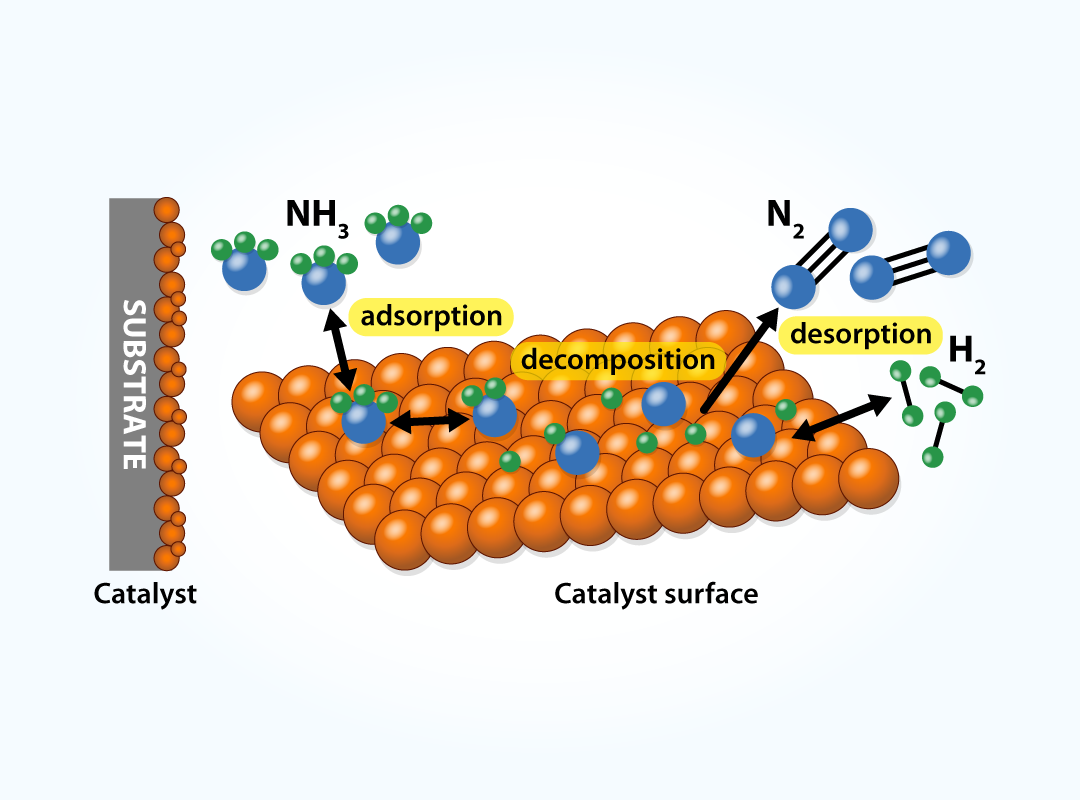
Ammonia delivers clean hydrogen
Hydrogen is a clean and sustainable energy source, but its storage and transportation remain major challenges. As a carbon-free hydrogen carrier, ammonia offers several advantages, such as high volumetric hydrogen storage density, high energy density, higher gravimetric hydrogen storage density than water, and the existence of well-established technologies for production, liquefaction, storage, and transportation. To release hydrogen, ammonia must be decomposed through a catalytic process called the ammonia decomposition process. Traditionally, noble metals like ruthenium (Ru) have been used as catalysts because of their high efficiency, but their high cost and scarcity hinder large-scale applications. To address this, in our research lab, we explore affordable and efficient alternatives based on transition metal (oxy)nitrides because of their unique electronic and structural properties, metal-like conductivity, stability/instability, etc. Despite their potential, transition metal (oxy)nitrides have been underexplored for ammonia decomposition. Therefore, we specifically emphasize the design of next-generation catalysts based on alkali transition metal (oxy)nitrides via optimizing their synthetic parameters, thermodynamics, kinetics, and mechanisms to enhance catalytic ammonia decomposition efficiency.
Relevant Publications
[1] M. Hojamberdiev, E.M. Heppke, T. Bredow, O. Gómez-Cápiro, K. Yubuta, K. Teshima, T.M. Ahamad, C. Lorent, S. Berendts, H. Ruland and M Lerch, Li2ZrN2: Crystal Structure, Electronic Properties, Oxidative Stability, Thermal Behavior, and Catalytic Activity in Ammonia Decomposition, Inorganic Chemistry, 2025, 64, 9519–9530.
Read the article
[2] M. Hojamberdiev, E.M. Heppke, T. Bredow, O. Gómez-Cápiro, K. Yubuta, K. Teshima, T. M. Ahamad, C. Lorent, J. A. Baldauf, H- Ruland, R. Pöttgen and M. Lerch, Revisiting Ordered Antifluorite-Type Li14Cr2N8O: Synthesis, Crystal Structure, Theoretical Perspectives, and Catalytic Activity for Ammonia Decomposition, Chemistry of Materials, 2024, 36, 9980−9990.
Read the article
[3] M. Hojamberdiev, A.L. Larralde, E.M. Heppke, O. Gómez-Cápiro, J.C. A. Camayang, T. Bredow, K. Yubuta, K. Teshima, T.M. Ahamad, C. Lorent, L. Kang, Y. Kayser, H. Ruland, S. DeBeer and M. Lerch, Antifluorite-Derived Li7MnN4: Revisiting the Crystal Structure and Catalysis in Ammonia Decomposition, 2005, submitted.